You tuck your child in with a mild fever, hoping for a peaceful night. But when you check again at 2:00 AM, their skin is burning up. If you are a parent, you know this moment well. That rising temperature at night triggers instant anxiety: Why is it always worse after dark? Is this dangerous? Should I wake them?
A rising temperature at night is a real physiological phenomenon, and understanding why it happens is the first step to staying calm.
In this guide, I will walk you through exactly what happens when a fever rises at night, how to manage it safely, and—most importantly—when to stop watching and seek medical help.
Why Does a Rising Temperature at Night Happen?
If you have ever wondered why your child’s temperature rises at night but seems manageable during the day, the answer lies in biology.
Our bodies follow a circadian rhythm. We produce a hormone called cortisol, which acts as a natural fever suppressant. Cortisol levels peak in the morning and drop to their lowest point during the night. When your child is fighting an infection, their immune system raises their internal thermostat. During the day, high cortisol levels keep that thermostat in check. But at night, when cortisol falls, the fever becomes more pronounced.
This is why a rising temperature at night is so common. It is not a sign that your child is getting sicker—it is simply the natural rhythm of the human body.
A fever that rises at night is expected. It does not automatically mean the illness is worsening.
What Parents Ask Most About Rising Temperature at Night (FAQ)
Is it normal for the temperature to rise at night?
Yes. This is a normal physiological response linked to the body’s circadian rhythm and the natural drop in cortisol levels overnight. It does not indicate that the illness is becoming more serious.
Should I wake my child to give medicine for a rising temperature at night?
Generally, no. If your child is sleeping comfortably despite a rising temperature at night, let them rest. Sleep is more important than the number on the thermometer. Only wake them if they seem distressed or uncomfortable.
How often should I check the temperature when it rises at night?
If your child is sleeping peacefully, checking every 3–4 hours is sufficient. If they are restless or you are concerned, you may check more frequently.
Can a rising nighttime temperature cause febrile seizures?
This is a common concern. According to the peer-reviewed medical journal Paediatrics and Child Health, febrile seizures are the most common form of seizure in children under 2 years old, accounting for approximately 2 to 4% of children in the UK.
What the evidence actually says:
Febrile seizures are triggered by a rapid rise in body temperature rather than by how high the temperature ultimately reaches. This rapid increase can happen as a fever rises, which is why a seizure may occur early in an illness—sometimes before a parent even realises the child has a fever. Importantly, febrile seizures can occur with what might seem like a mild fever. In some cases, the seizure itself is the first sign that your child has a fever at all.
Are they dangerous?
Most febrile seizures are harmless and do not cause brain damage unless they are prolonged. Multiple NHS trusts explicitly state this in their parent information leaflets. Hull University Teaching Hospitals NHS Trust confirms, “Febrile convulsions are not harmful to your child and are not a cause of brain damage.” Cambridge University Hospitals adds that, while they are “very concerning and very upsetting for parents and carers to witness”, serious harm is rare.
What to do if a seizure occurs:
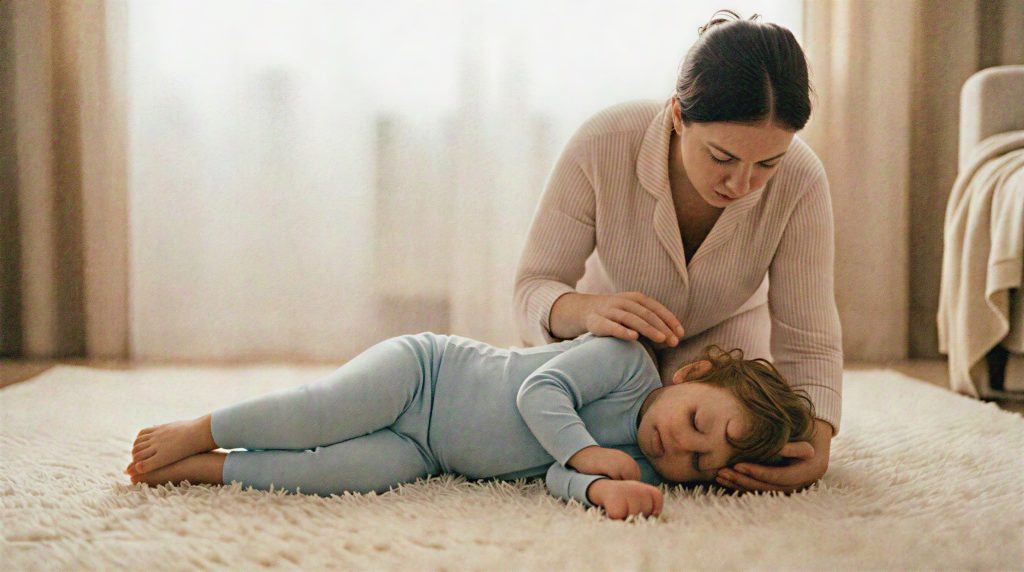
- Stay calm and lay your child on their side on a soft surface (the recovery position)
- Protect their head with your hands or something soft
- Move furniture or dangerous objects out of the way
- Do not restrain or shake your child
- Do not put anything in their mouth
- Time the seizure—note when it starts and ends.
When to see the doctor.
- The seizure lasts longer than 5 minutes.
- Another seizure follows immediately after the first.
- Your child does not wake up afterwards.
- Your child has difficulty breathing or looks very unwell.
- You notice a rash that does not fade when pressed (the glass test).
Can fever medicine prevent them?
No. Giving paracetamol or ibuprofen to reduce fever will not prevent a febrile seizure. Cambridge University Hospitals explicitly states, “Research has also shown that using medication to control fever, such as paracetamol (Calpol®) or ibuprofen (Nurofen®), does not prevent further febrile convulsions. “These medicines should only be given if they improve other symptoms like muscle aches and pains.
Will it happen again?
According to Harvard Health Publishing, “more than one in three children who have had a febrile seizure will have another one within one year.” ” Most children grow out of them by age 6, and only about 1–2 in 100 go on to develop epilepsy, a rate only slightly higher than that of children who have never had a febrile seizure.
Nighttime Fever Protocol
When you are sleep-deprived and staring at a thermometer, you need a simple, repeatable plan. Here is your protocol for managing a rising temperature at night.
1. Hydration First—Always
A fever that rises at night burns through fluids faster than your child can replenish during sleep. Dehydration is a common reason a sick child needs medical attention, not the fever itself.
- For babies: Offer frequent breastfeeds or bottle feeds, even if they take small amounts.
- For toddlers and older children: Keep a cup of water, oral rehydration solution, or an ice pop nearby. Offer small sips every 15–20 minutes if they are awake.
- Red flag: If your child has gone 8–10 hours without a wet diaper, cries without tears, or has a dry mouth, they may be dehydrated. (Refer to my detailed guide on Dehydration.)
2. Dress for Comfort, Not for Warmth
When you feel a rising temperature at night, your instinct may be to pile on blankets because your child feels cold. Resist this urge.
- Dress your child in lightweight cotton pyjamas
- Keep the room cool and well-ventilated
3. To Medicate or Not?
This is the most common question I get as a nurse about rising temperature at night.
If your child is distressed and you are considering medication, speak to your pharmacist or GP for advice on what is appropriate for your child’s age and weight. If you do give medication, always follow the instructions on the packaging. Remember: a fever may return when the medication wears off—this is normal and means your child’s body is still fighting the infection.
When a Rising Temperature at Night Becomes an Emergency
Even with the best home care, there are times when a rising temperature at night signals something serious. Trust your gut. If something feels wrong, seek help.
Seek emergency care immediately if:
- Infant under 3 months: Any fever of 38°C (100.4°F) or higher requires immediate medical evaluation. This is non-negotiable.
- Difficulty breathing: Nostrils flaring, ribs pulling in with each breath (chest indrawing), wheezing, or grunting (NHS UK)
- Unresponsiveness: Your child is limp, floppy, or cannot be woken
- Stiff neck: They cannot touch their chin to their chest—this can be a sign of meningitis
- Severe pain: Persistent headache, stomach pain, or inconsolable crying
- Non-blanching rash: A rash that does not turn white when pressed with a glass—this can be a sign of meningitis
- Persistent fever: Fever lasting more than 5 days
- A febrile seizure lasting longer than 5 minutes
Related Childhood Illnesses: Connecting the Dots
A rising temperature at night rarely happens in isolation. It often accompanies other symptoms. Here is how my other guides can help you manage the full picture:
- Fever: My complete guide to understanding and managing fevers in children
- Dehydration: The #1 complication of fever—learn exactly what to watch for
- Vomiting: When fever and vomiting occur together, hydration becomes even more critical
- Diarrhoea: Frequent stools combined with fever can rapidly deplete fluids
- Constipation: Surprisingly, constipation can sometimes cause low-grade fevers due to gut inflammation
Final Thoughts: Staying Calm When Temperature Rises at Night
A rising temperature at night is one of the most anxiety-provoking moments in parenting.
But here is what I want you to remember: a fever that rises at night is usually a sign that your child’s immune system is doing exactly what it was designed to do. Your job is not to eliminate the fever—it is to keep your child comfortable, hydrated, and safe.
Keep this guide bookmarked for those 2:00 AM moments. Trust your instincts, and remember the red flags.
You got this.
If you liked this post, you might also like:
Fever After Vaccination: What Parents Should Expect and When to Worry
Fever in Children: The “Wait or Worry” Checklist
Child Fever: What Is Normal and What Isn’t
Clinic or Hospital for a Sick Baby? Emergency Warning Signs Parents Should Know
Baby Symptoms Guide: What’s Normal & When to Worry (A Nurse’s Guide for Parents)

Nurse K is a practising PHC nurse in South Africa. She writes anonymously to help busy mums raise healthy little ones. Real advice. No jargon. No judgement.
Medical Disclaimer
Medical Disclaimer
The information provided on BusyMumsWorld is for general informational and educational purposes only. This website does not constitute medical advice, diagnosis, or treatment.
About Me
I am a registered nurse with the South African Nursing Council (SANC). I draw upon my nursing training and clinical experience to provide helpful, evidence-informed information for mothers, babies, and families. However, my role on this website is that of an educator and content creator, not your personal healthcare provider.
No Nurse-Patient Relationship
Your use of this website does not create a nurse-patient relationship between you and me. The content on this site does not replace an in-person clinical assessment, physical examination, or professional medical consultation. In accordance with the Nursing Act, 2005 (Act No. 33 of 2005) and the SANC Code of Ethics, I clearly distinguish between my role as a registered nurse in clinical practice and my role as a content creator.
For Babies and Children
Content related to infant and child health is for educational purposes only. Every child is unique. What works for one child may not be appropriate for another. Always consult your paediatrician, clinic sister, family doctor, or other qualified healthcare provider regarding any medical concerns about your child, including changes in behaviour, feeding, sleep, growth, or physical symptoms.
For Mothers
Content related to pregnancy, antenatal care, postpartum recovery, breastfeeding, and maternal health is for educational purposes only. Your healthcare needs are individual and may change during pregnancy and the postnatal period. Always seek guidance from your doctor, midwife, obstetrician, lactation consultant, or local clinic for any questions about your or your baby’s health.
South African Context
Where possible, I aim to provide information relevant to the South African healthcare context, including public and private healthcare considerations. However, healthcare resources, protocols, and availability may vary by province, facility, and individual circumstance. Always confirm information with your own healthcare provider.
SANC Compliance
In compliance with the rules and ethical guidelines of the South African Nursing Council (SANC):
- I clearly state that the information on this site does not constitute the practice of nursing as defined in the Nursing Act
- I do not offer individualised nursing assessments, diagnoses, or treatment plans through this website
- I encourage all readers to seek in-person care from registered healthcare professionals for their specific health needs
- I maintain professional boundaries by not providing specific medical advice in response to comments, emails, or messages
Emergency Warning
If you or your child is experiencing a medical emergency, do not use this website for advice. Call emergency services immediately. Alternatively, go to your nearest hospital emergency department, clinic, or doctor immediately.
Do not delay seeking emergency care because of something you have read on this website.
Limitation of Liability
I make every effort to ensure the accuracy of the information published on this site. However, medical knowledge is constantly evolving, and information may become outdated. I cannot guarantee that all information is complete, current, or accurate for every individual circumstance. I assume no responsibility or liability for any errors or omissions in the content of this site. Your use of this website is at your own risk.
Affiliate Disclosure
BusyMumsWorld participates in affiliate marketing programmes. This means that some links on this site may be affiliate links. If you choose to purchase through these links, I may earn a small commission at no additional cost to you.
My Commitment to You
I am a registered nurse with the South African Nursing Council (SANC). My recommendations are based on my professional knowledge, clinical experience, and genuine belief that a product may be helpful to my audience. Affiliate partnerships do not influence my clinical judgement, the information I provide, or my commitment to evidence-based content.
Important Note
Products mentioned on this site are for informational purposes only. If a product makes medical claims, please consult your doctor, paediatrician, or other qualified healthcare provider before use. My nursing credentials do not constitute an endorsement of any specific product, and I do not receive compensation for clinical recommendations.
Last Updated: March 2026